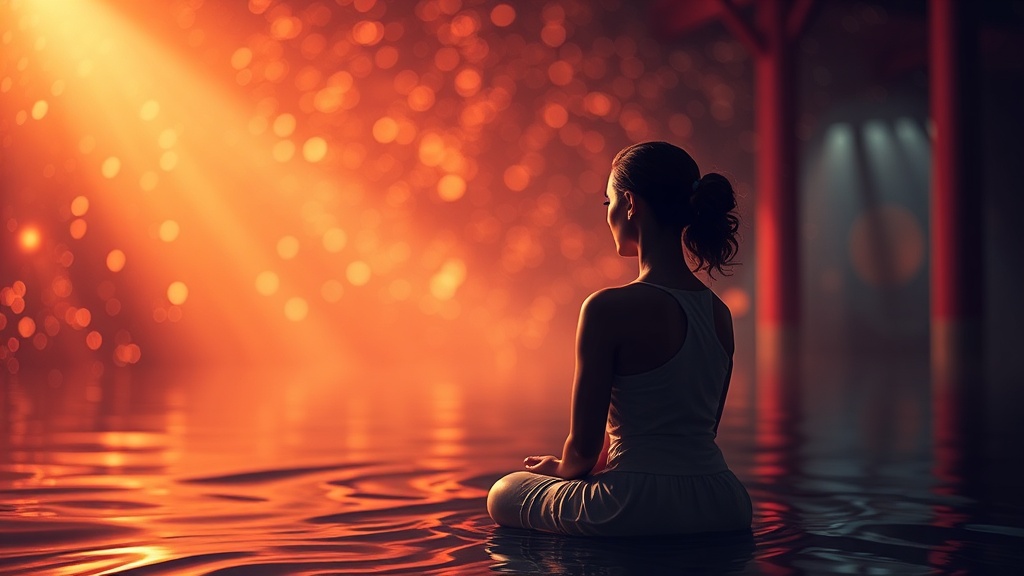
Finding Stillness Through Rhythmic Visualizations

Imagine you’re lying in bed, eyes closed, but your brain is stuck on a loop of yesterday’s awkward conversation or tomorrow’s to-do list. This post explores how rhythmic visualization techniques can break that loop by giving your mind a predictable, soothing pattern to follow. Instead of fighting the thoughts, you'll learn to redirect them toward a steady, visual beat that naturally slows your heart rate and settles your nervous system.
Most people think meditation requires sitting perfectly still in a silent room, but that's often a lie. For many of us, absolute silence is actually quite loud because it leaves too much room for the internal chatter to take over. Rhythmic visualization offers a middle ground. It gives the "thinking" part of your brain a job to do—a repetitive, low-stakes task—so the "feeling" part of your brain can finally relax.
What is Rhythmic Visualization?
Rhythmic visualization is the practice of mentally observing a repeating, predictable movement or pattern to induce a state of deep relaxation. It works by providing a focal point that mimics the natural rhythms of the body, like breathing or a heartbeat. When you focus on a visual rhythm—like waves hitting a shore or a pendulum swinging—you're essentially training your brain to sync up with a steady pace.
Think of it like a metronome for your consciousness. If your thoughts are a chaotic storm, these visual rhythms act as an anchor. You aren't trying to stop the thoughts; you're just giving your eyes (even though they're closed) a much more interesting, calmer thing to look at.
I often find that if I can't shut my brain off, I use a technique similar to body scanning to ground myself. The difference here is that instead of checking in with physical sensations, you're checking in with a mental image.
It's a bit like watching a fireplace or a lava lamp. There's no plot, no tension, and no way for the image to "fail" you. It just exists. This lack of stakes is exactly why it works.
Common Visual Rhythms
Depending on your personality, certain rhythms will feel more effective than others. Some people find the ocean too "active," while others find a spinning geometric shape too "mechanical."
- Natural Cycles: The rise and fall of a tide, the swaying of tall grass, or the rhythmic pulsing of a jellyfish.
- Geometric Patterns: A slow-moving spiral, a rotating mandala, or a single point of light expanding and contracting.
- Mechanical Rhythms: A pendulum swinging, a clock hand ticking, or a glowing ember pulsing in a hearth.
How Can I Use Visualization to Fall Asleep Faster?
You can use visualization to fall asleep faster by pairing a mental image with your natural breathing pattern. The goal is to make the visual movement perfectly synchronous with your inhalation and exhalation. When the image and your breath are in sync, the brain begins to enter a state of "alpha" or "theta" waves, which are the precursors to sleep.
Here is a simple three-step process to try tonight:
- Choose your anchor: Pick a visual that feels "heavy" or "slow." If you're feeling high-anxiety, a heavy, slow-moving wave is often better than a fast-spinning star.
- Set the tempo: Close your eyes and imagine the movement. If you chose a wave, see it swell as you breathe in, and see it recede as you breathe out.
- The "Drift" Technique: If a thought enters your mind (and it will), don't fight it. Acknowledge it, then gently bring your focus back to the rhythm of the wave.
It's helpful to have a "starter" image ready so you don't spend twenty minutes trying to decide what to visualize. I keep a mental list of three "go-to" images. If the wave isn't working, I switch to the pendulum. If that's too boring, I move to the glowing ember.
If you find your mind is too racing for a visual, you might find more success with a gentle brain dump first to clear the deck. Once the mental clutter is out, the visualization can actually take hold.
It's worth noting that your first few attempts might feel clunky. You might "lose" the image for a few seconds. That's fine. Just start again. It's a practice, not a performance.
Does Visualizing Help with Anxiety?
Yes, rhythmic visualization can help with anxiety by shifting the brain from the sympathetic nervous system (fight or flight) to the parasympathetic nervous system (rest and digest). By focusing on a repetitive, non-threatening stimulus, you are signaling to your amygdala that there is no immediate danger in your environment.
This is a documented physiological response. When we focus on a single, rhythmic point, our cognitive load decreases. We aren't solving problems or predicting the future; we are simply observing. This shift is vital for anyone dealing with sleep-onset insomnia caused by racing thoughts.
| Type of Stimulus | Best For... | Energy Level |
|---|---|---|
| Natural (Waves/Clouds) | High Anxiety/Restlessness | Low/Flowing |
| Geometric (Spirals/Dots) | Deep Focus/Mental Wandering | Steady/Consistent |
| Mechanical (Pendulums/Clocks) | Mental Overdrive/Logic-heavy statesStrict/Rhythmic |
One thing to watch out for: if you're a highly analytical person, a geometric shape might actually keep you awake because you'll start trying to "calculate" the pattern. If that happens, move to something organic. The autonomic nervous system responds much more readily to organic, unpredictable-yet-rhythmic patterns like the movement of water or leaves in the wind.
Finding the Right "Speed"
A common mistake is trying to visualize something too fast. If your visual rhythm is faster than your natural breathing, you'll actually increase your heart rate. You want the visual to be slightly slower than your current pace. If you feel your breathing is shallow and fast, visualize something incredibly slow—like a heavy, thick fog rolling over a hill. This "drags" your physiology down to a calmer state.
I've found that using a physical anchor helps, too. If you're using a visual of a glowing light expanding, you can try to match that expansion with a physical sensation in your chest. It bridges the gap between the mind and the body.
If you're interested in how this connects to more tactile sensations, you might want to look into sensory shifts for your evening transition. It's all part of the same goal: moving from the "doing" mode of the day into the "being" mode of the night.
Sometimes, the most effective tool is the simplest one. You don't need a fancy app or a high-tech meditation cushion. You just need a rhythm. Whether it's a mental pendulum or the imagined swell of the Pacific Ocean, the consistency of the pattern is what does the heavy lifting. It's about finding that one steady beat in the middle of the noise and leaning into it until the world fades out.